Am I the last one to have stumbled upon James Patterson's great website for encouraging kids to become lifelong readers? Patterson's advertising background shows in the best possible light on this well-constructed easy to use website. He has great lists of books, tips for parents, and much much more. Check it out!
February 26, 2010

February 22, 2010
Twitter and its Possible Uses
This week's 23ThingsKansas lesson is on microblogging--so now I have a Twitter account. My Twitter handle is lovestheprairie.
I am now following tweets from several libraries, Library Journal, and a parenting book publisher. I can see some great professional uses for libraries. Libraries could have individual accounts for various departments to keep patrons apprised of programs. It could also be a great way to communicate urgent changes, such as program cancellations due to weather or low interest. It seems that Twitter may be a type of "real time" communication that reaches a target audience. It would also be a good way to create targeted readers' advisory--a kind of "what do I read next?" from one's favorite librarian.
On a personal note, I think Twitter in addition to Facebook and a blog and email may be more information bombardment that I can handle. I may change my mind, but as a non-text message person, it's one more thing to keep track of. If I were "text ready" and used my cellphone heavily or was an iPhone user, it would make more sense.
I am now following tweets from several libraries, Library Journal, and a parenting book publisher. I can see some great professional uses for libraries. Libraries could have individual accounts for various departments to keep patrons apprised of programs. It could also be a great way to communicate urgent changes, such as program cancellations due to weather or low interest. It seems that Twitter may be a type of "real time" communication that reaches a target audience. It would also be a good way to create targeted readers' advisory--a kind of "what do I read next?" from one's favorite librarian.
On a personal note, I think Twitter in addition to Facebook and a blog and email may be more information bombardment that I can handle. I may change my mind, but as a non-text message person, it's one more thing to keep track of. If I were "text ready" and used my cellphone heavily or was an iPhone user, it would make more sense.
February 16, 2010
Social bookmarking is del.icio.us!
This week's 23Things module is on tagging and social bookmarking. I'm so glad to know what this is all about! I've hated having some of my website bookmarks at home and others at work. Now I can store them in one place, log in anywhere, and access them. I can organize them and cross reference them--woo hoo!!! No more will I need to remember where I filed that bookmark in my favorites. And what a great excuse, um, reason to weed out all those old dead links and unused sites. This is a great tool for librarians--or anyone who likes to be organized.
February 10, 2010
RSS--It really IS really simple syndication
Today I created my Google Reader account and subscribed to some of my favorite book review and news feeds. Now I won't miss the Sunday NYTBR. Now I can see what's cooking at Horn Book, a great resource for children's librarians. Now I don't have to worry that I'll miss "Only A Game," NPR's great sports show for the armchair sports fan. And I can catch up when I choose to. I only have one question: what took me so long? 23 Things Kansas, my hat is off to you. You're adding stars to our information diva crowns.
What did I subscribe to? Oh, way too much, I'm sure, but time will be the judge of that. Here's the list (which immediately loaded 85 posts):
What did I subscribe to? Oh, way too much, I'm sure, but time will be the judge of that. Here's the list (which immediately loaded 85 posts):
- Horn Book Magazine
- School Library Journal
- National Public Radio
- Only a Game
- Ominivoracious
- The New York Times Book Review
February 02, 2010
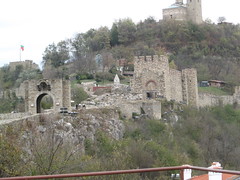
One of my Flickr account photos.
I took a trip to Bulgaria a few years ago, and one of the cities we visited was Veliko Turnovo. It is the site of an amazing fortress called Tsarevets. The place is replete with history--there's even a spot where enemies were thrown off the walls into the valley. I found Bulgaria fascinating.
23 Things Flickr!
Our library already has a virtual tour on Flickr, so I decided to do something else. I now have a Flickr account with some tagged photos, including some from library activities. I've even succeeded in linking my blog and Flickr--a precision operation, to be sure!
I decided to explore the Libraries and Librarians group. There are some architectural wonders there! What really caught my attention was this photograph of the sign outside the library in Santa Caterina Palopó in Guatemala. It's the text that thrills me: Heart of Knowledge. That's the library all right. And I think librarians have both heart and knowledge.

I decided to explore the Libraries and Librarians group. There are some architectural wonders there! What really caught my attention was this photograph of the sign outside the library in Santa Caterina Palopó in Guatemala. It's the text that thrills me: Heart of Knowledge. That's the library all right. And I think librarians have both heart and knowledge.
January 30, 2010
23ThingsKansas--Online Conferencing Experience.
N.B. This is a duplicate posting. I posted these comments on the 23ThingsKansas site earlier today.
I decided to sample a couple of the webinar options, and I got some great ideas (as well learning about some new concepts/technology tools like bee tags!) from the Infopeople archived webinar on revitalizing the library experience. For example, rethinking hospitality: how welcoming is our building? the entrance? How do we get people to think of it as a place for them, like the British museum with the slogan, "the free destination for the incurably curious?" I found the format for this webinar easy to use--it offered chat and Q&A options.
One of the nice facets of archived webinars is the ability to pause as well as to skip to slides to which one might want to return.
I nipped into the Kansas Tax webinar using Wimba and found it quite similar to the format of Infopeople. I have participated in a SirsiDynix webinar in the past, and I found it easy to interact. I contrast this with a recent training webinar experience I had. The firm used Netspoke for video conferencing, and while the information was good, there was some lag time between screens from the presenter. In addition, participants had to phone in as well as be logged in. That was awkward. i don't understand why they didn't opt for a platform that would allow participants to headsets. Moreover, one had to press a certain code in order to mute and unmute the phone for questions.
I think online conferencing is the future for committee meetings where members are separated by great physical distance. They also enable groups to archive those meetings for members who had schedule conflicts. This would allow absent members to catch up and follow up as needed.
I decided to sample a couple of the webinar options, and I got some great ideas (as well learning about some new concepts/technology tools like bee tags!) from the Infopeople archived webinar on revitalizing the library experience. For example, rethinking hospitality: how welcoming is our building? the entrance? How do we get people to think of it as a place for them, like the British museum with the slogan, "the free destination for the incurably curious?" I found the format for this webinar easy to use--it offered chat and Q&A options.
One of the nice facets of archived webinars is the ability to pause as well as to skip to slides to which one might want to return.
I nipped into the Kansas Tax webinar using Wimba and found it quite similar to the format of Infopeople. I have participated in a SirsiDynix webinar in the past, and I found it easy to interact. I contrast this with a recent training webinar experience I had. The firm used Netspoke for video conferencing, and while the information was good, there was some lag time between screens from the presenter. In addition, participants had to phone in as well as be logged in. That was awkward. i don't understand why they didn't opt for a platform that would allow participants to headsets. Moreover, one had to press a certain code in order to mute and unmute the phone for questions.
I think online conferencing is the future for committee meetings where members are separated by great physical distance. They also enable groups to archive those meetings for members who had schedule conflicts. This would allow absent members to catch up and follow up as needed.
Subscribe to:
Posts (Atom)